The Show Only Happens Once — Your Photographs Need to Keep It Alive

There is something very different about photographing live performance.
You don’t get to stop the action. You don’t get to ask everyone to go back and do it again. And you definitely don’t get to say, “Could you just hold that expression for me?”
The performance happens once. My job is to catch it.
Theatre photography is about timing
The obvious challenge with theatre photography is the light.
Stages can go from almost completely dark to intensely bright in seconds. Colours change. Spotlights move. Performers move in and out of shadows. But technically difficult lighting is only part of it.
The bigger challenge is timing. There is usually a fraction of a second where a moment comes together.
A look between two performers. A hand reaching out. Someone hitting the top of a jump. A perfectly timed reaction. The culmination of a scene. Half a second earlier and it hasn’t happened yet. Half a second later and it has gone. That is what makes photographing live performance so interesting.
You have to watch the story, not just the people
A photographer can take technically sharp photographs all evening and still miss the performance.
Theatre photography isn’t simply about photographing whoever happens to be standing under the brightest light.
You have to pay attention to what is happening on stage.
Who matters in that moment?
Where is the audience being asked to look?
What is about to happen?
Sometimes the strongest photograph is the main character in the spotlight.
Sometimes it is the person standing three feet away reacting to them.
That is why understanding the rhythm of a performance matters.
The better you can anticipate what is coming, the more likely you are to capture the moment rather than chase it.
Movement needs to feel like movement
Dance, musical theatre and live performance are full of motion.
And there is a temptation to think that every successful photograph needs to freeze that movement completely.
It doesn’t.
Sometimes you want absolute sharpness.
Sometimes a little movement gives the photograph energy.
What matters is that the image feels intentional.
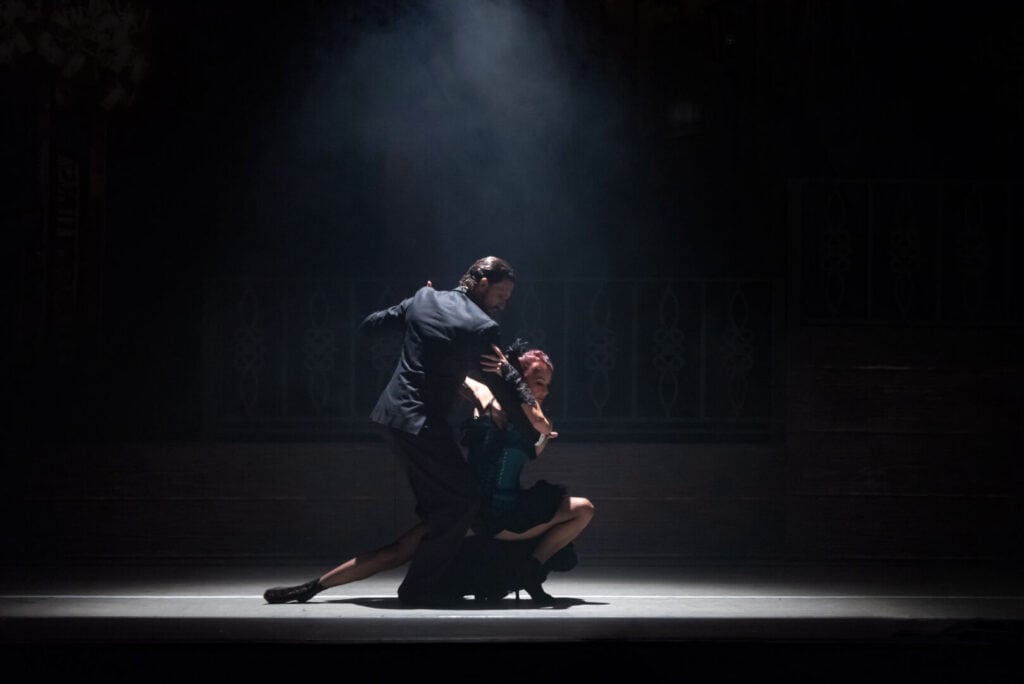
A dancer at full extension, an actor mid-gesture or a performer caught in a pool of light can tell you far more about the production than a photograph of somebody simply standing on a stage.
The photographer should never become part of the show
One of the most important skills in theatre photography is knowing how to disappear.
The audience hasn’t bought a ticket to watch me work.
The performers shouldn’t have to think about me either.
That means moving carefully, choosing positions properly and understanding when not to move at all.
It also means working quietly.
Live performance is immersive, and a photographer constantly changing position or drawing attention to themselves can break that immersion very quickly.
The aim is to capture what is happening without affecting what is happening.
The photographs have a life long after the curtain comes down
The value of theatre photography isn’t limited to the night of the performance.
Those photographs become part of the way the production is remembered and promoted.
They can be used for press coverage, social media, websites, posters, programmes, future productions and funding applications.
For dance schools and performing arts organisations, they can also become part of the story of the organisation itself.
They show the standard of the work.
The atmosphere.
The scale of a production.
And, perhaps most importantly, the people involved.
A good set of performance photographs should make someone who wasn’t there wish they had been.
Some of my favourite images happen between the obvious moments
Big dramatic scenes are wonderful to photograph.
But some of the strongest images come from the quieter moments.
A performer waiting in the wings.
A glance across the stage.
A tiny reaction the audience may barely notice.
That moment just before somebody steps into the light.
Those are often the photographs that feel most human.
And they are the photographs people remember.
When the performance is gone, the photographs remain
Theatre is temporary by its very nature.
Weeks or months of rehearsals build towards something that may only exist for a handful of performances.
Then the lights go down, the set comes apart and everybody moves on.
Photography gives that work a longer life.
It preserves the scale of it, the emotion of it and the moments that would otherwise disappear.
The show may only happen once.
The photographs shouldn’t feel temporary.
If you have a production, performance, dance show or live event coming up and you want photographs that capture more than just what happened on stage, I’d love to hear about it.
I photograph theatre and live performance across East Anglia, creating images that can be used long after the curtain comes down — for marketing, press, social media, programmes and future promotion.
If you’d like to talk about photography for your next production, get in touch and let’s make sure the moments don’t disappear when the lights go down
About the author
Denise Brady is a branding photographer based in Suffolk, working with businesses across Norfolk, Suffolk, East Anglia and London. She specialises in professional branding photography, event photography, property photography and theatre photography, helping businesses build trust through authentic, story-led imagery..